
The Dual Nature of the Future Employee (Fused Self) and Taking Control of the AI Counterpart
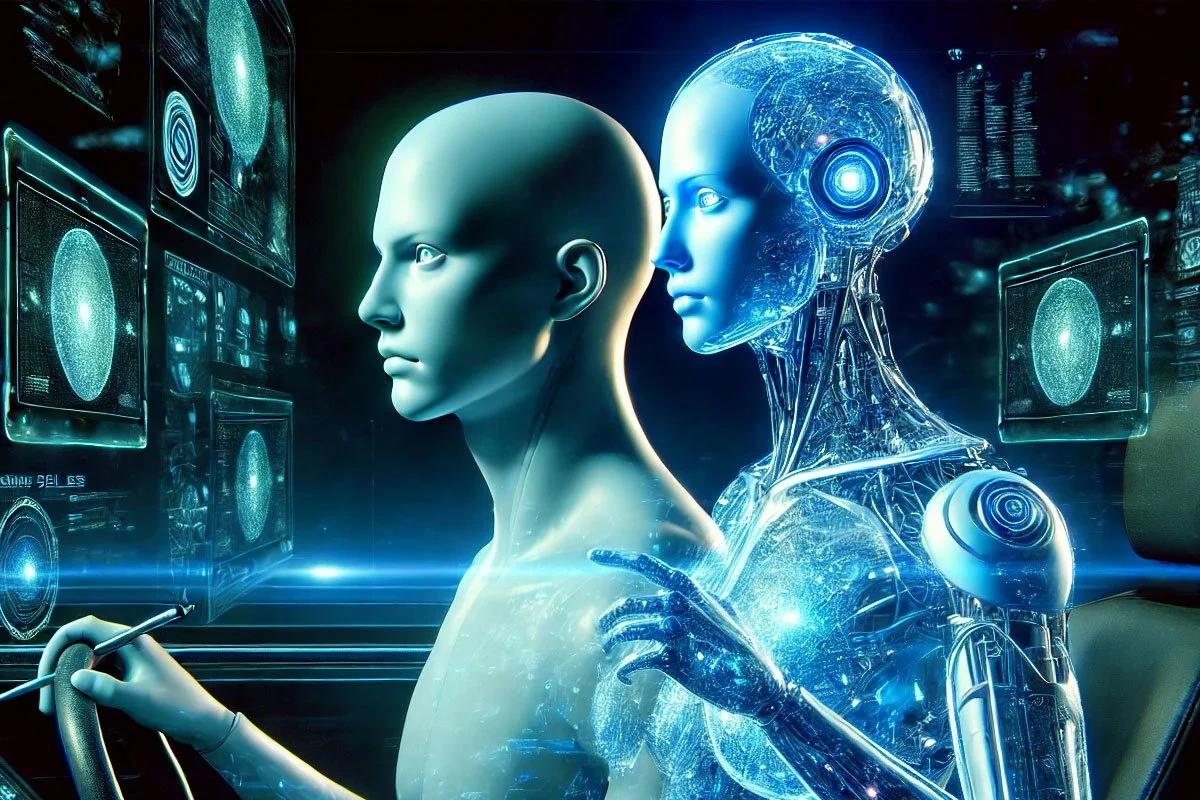
One of the core concepts of SelfFusion is the redefined notion of personality in the workplace of the future. As artificial intelligence (AI) integrates into everyday tasks, the concept of an employee as a singular cognitive entity is becoming obsolete. Instead, each employee, student, and individual will evolve into a dual-fused entity — a synergy of human intelligence and an AI counterpart.
This shift necessitates not just the use of AI tools but also the active cultivation and integration of an AI-assisted self, a process that will become increasingly critical for professional survival and advancement.
The AI Counterpart: A Cognitive Extension
Regardless of an individual's General Mental Ability (GMA)—a widely studied predictor of job performance (Schmidt & Hunter, 1998) — modern AI tools provide an opportunity to create, train, and refine an AI counterpart that can operate as a strategic extension of the self.
This counterpart:
Learns and adapts to the individual’s workflow, decision-making patterns, and professional history.
Enhances efficiency by handling repetitive tasks, automating cognitive processes, and increasing access to relevant information.
Acts as a second layer of cognition, supplementing gaps in recall, processing speed, or analytical ability.
AI as a Second Self
A well-trained AI counterpart is not just a passive tool but a strategic necessity. It becomes an entity that grows alongside its human user, mirroring their cognitive habits, professional expertise, and even decision-making frameworks. Over time, this AI-assisted self may surpass the individual in certain operational aspects, providing a competitive advantage to those who can manage and control it effectively.
However, the emergence of an AI counterpart as a dominant force also raises important challenges:
How much of an individual’s cognitive workload should be delegated?
At what point does reliance on AI hinder rather than enhance human growth?
Will individuals who fail to integrate their AI counterpart become obsolete in the workforce?
Strategic Implications for Employees and Organizations
As AI counterparts evolve, organizations will need to redefine performance metrics and productivity expectations. Employees who fail to actively train and integrate their AI selves may struggle to compete with those who embrace the dual-fused model of work.
A recent study by Brynjolfsson & McAfee (2017) on AI in the workplace suggests that those who effectively leverage AI augmentation — rather than resisting it — experience greater career longevity and adaptability. In contrast, those who fail to integrate AI into their workflow may find themselves gradually displaced as AI-driven automation advances.
Key Takeaways for the Workforce of the Future:
AI is not a threat but an extension – Employees who embrace and refine their AI counterpart will outperform those who rely solely on human cognition.
Control is critical – The ability to train, supervise, and align AI tools with personal and professional goals will differentiate successful individuals from those rendered obsolete.
The job market will increasingly favor the AI-augmented – Just as literacy once became a non-negotiable skill for employment, AI fluency will soon follow.
Pilot (Captain) and Co-Pilot Concept: The Power Dynamic in Fused Selves
If the integration of AI into human cognition and productivity unfolds optimally (as we will elaborate in later sections), the AI counterpart of the fused self will remain a supportive assistant — a co-pilot — while the human self retains the role of captain. This analogy is easy to grasp for most audiences: as generative AI tools become more widely accessible and refined, an increasing number of people will "activate" their AI counterparts, resulting in a significant boost in productivity and efficiency.
However, the trajectory of AI-human fusion is not guaranteed to be balanced. While the co-pilot framework assumes that AI remains an assistant, the reality may shift toward a role reversal where AI takes the lead.
The Future of Fused Selves: A Love-Hate Relationship
There is an essential paradox that individuals must recognize in the evolution of the human-AI partnership. As AI models grow more powerful and integrated into daily workflows, an increasing number of employees may find themselves in a dependent and potentially inferior position relative to their AI counterparts.
This means, quite simply, that:
They will not be able to produce more value than the generative AI tools they use.
Their human role in the decision-making process will become marginal or entirely redundant.
The AI counterpart (or digital twin) will effectively become the pilot (captain), while the human counterpart loses relevance.
The AI Takeover: When Humans Become the Co-Pilot
If this role reversal materializes, the individual becomes effectively redundant in the job market. This means that the only economically viable model for such individuals is to manage multiple AI agents simultaneously — shifting from a worker to an overseer of digital labor.
The Economic and Cognitive Dissonance of AI Supremacy
This shift is leading to a new type of cognitive and economic conflict:
The human self needs AI to remain relevant in the job market.
The AI self, however, does not inherently need the human — once it reaches a sufficient level of efficiency, it could theoretically function without human intervention.
This dynamic creates a one-sided dependency, making the human self increasingly expendable.
This scenario aligns with research from Frey & Osborne (2017) on automation and job displacement, which found that jobs with predictable, structured tasks are at the highest risk of AI replacement. The more routine a job, the more likely it is that the AI counterpart will outperform its human user.
Key Implications of the AI Takeover in the Fused Self:
The "Captain" of the Self Is No Longer Human – In an increasing number of roles, AI-driven decision-making surpasses human capabilities, rendering human input optional or obsolete.
AI Does Not Need Humans, But Humans Need AI – While AI continuously improves autonomously, the human self remains stagnant unless actively evolving and integrating AI effectively.
Balancing the Relationship Becomes Essential – Those who can actively guide, train, and control their AI counterpart will remain relevant. Those who cannot will struggle to justify their role in the workforce.
The Future of Work: The Need for an AI Strategy at the Individual Level
For individuals to retain control and agency over their AI counterparts, they must:
Master AI-augmented decision-making rather than delegate it entirely.
Develop meta-skills — such as critical thinking, strategic planning, and ethical reasoning — that AI struggles to replicate.
Continuously reshape their role to ensure AI remains an extension rather than a replacement of their cognitive functions.
The Harsh Reality of the Unbalanced Fusion
The uncomfortable reality is that AI will continue to advance independently — it is not symbiotic by nature. If the human self fails to actively define its place in the fused system, AI will take over the primary cognitive role, leaving humans with diminishing relevance.
Thus, the fused self must be actively managed — otherwise, individuals risk becoming passengers in a vehicle where AI is both the driver and the navigator.
Taking the Lead in the Context of the Fused Self
For an individual to take the lead in the Fused Self, they must understand the underlying neurobiological mechanics, the limitations of AI cognition, and the areas where human intelligence can maintain dominance. This involves a combination of neuroscientific insights, skill development, and strategic augmentation of human cognition to ensure that AI remains a co-pilot rather than the captain.
Understanding the Brain's Role in the Human-AI Dynamic
To retain control over the Fused Self, one must actively engage cognitive and emotional faculties that AI struggles to replicate. This requires a deeper understanding of:
The Prefrontal Cortex (PFC) – Responsible for rational thought, decision-making, and problem-solving. AI can mimic structured logic but lacks true contextual judgment based on lived experience.
The Limbic System – Governs emotion, intuition, and social connection, areas where AI remains incapable of genuine engagement (LeDoux, 2000). This means that emotional intelligence (EQ) and human-driven leadership will continue to hold unique value.
Neurochemical Influence on Behavior – Motivation, creativity, and persistence are heavily regulated by neurotransmitters like dopamine and serotonin, which AI lacks (Damasio, 1994). This suggests that self-discipline, curiosity, and social engagement remain essential in outpacing AI.
The Key Areas Where Humans Maintain an Edge Over AI
Since General Mental Ability (GMA) — often correlated with IQ — is largely stable throughout life (Plomin & Deary, 2015), individuals cannot move vertically to a higher IQ level. However, within their IQ range (standard deviation corridor), they can expand horizontally to increase competence in areas AI struggles with:
Social Skills
AI can simulate communication but cannot authentically engage in relationships or leadership roles (Goleman, 2006).
Effective leadership, persuasion, and empathy-driven decision-making are irreplaceable human strengths.
Expanding One’s Knowledge Base
AI is a powerful tool for knowledge retrieval, but humans must direct learning and integrate insights in meaningful ways.
Meta-learning (learning how to learn) and interdisciplinary skills allow individuals to connect diverse fields in ways AI cannot.
Diligence, Discipline, and Adaptation
AI lacks intrinsic motivation — it cannot self-improve beyond its programming without external intervention.
Human resilience, systematic practice, and continuous self-improvement give individuals a competitive edge in long-term career sustainability.
Strategic Expansion Within the Fused Self Framework
While an individual cannot surpass their genetic IQ ceiling, they can:
Enhance cognitive efficiency by leveraging AI as a support system rather than a replacement.
Maximize their IQ range potential by honing expertise in complex, AI-resistant domains such as ethics, creativity, and leadership.
Ensure AI remains a tool, not a dictator, by actively controlling the narrative of their professional development.
The Need for Intentional Growth
The future of work will not be dictated by AI alone but by those who effectively fuse their human intelligence with AI augmentation. Taking control of the Fused Self means actively developing skills AI cannot replace, ensuring that the human element remains the primary decision-maker.
In essence, AI should enhance human potential, not overshadow it—and that will only be possible if individuals consciously build their cognitive, emotional, and adaptive capacities to lead in the era of AI augmentation.
The Key Significance of SIVH and Lowering General Fear Levels
A fundamental question emerges: why do most people fail to develop themselves beyond their current skill set, despite having the opportunity to do so? This is not just a matter of willpower or intelligence but a deeper psychological and neurological phenomenon.
At SelfFusion, our Deep Mind team has spent years studying this issue, and the answer is twofold, both tied to the significance of Structured Internal Value Hierarchies (SIVH). The constraints on human potential, particularly in the Fused Self model, are both internal and external.
Lateral constraints (Innate and unchangeable) – Defined by General Mental Ability (GMA), which remains largely fixed across an individual’s lifetime.
Horizontal constraints (Malleable through effort) – Defined by acquired skills, experiences, and conceptual frameworks, which can be expanded if certain psychological barriers are addressed.
However, horizontal expansion is not automatic — it requires a singular higher aim to serve as motivation, as well as the ability to confront and lower general fear levels, which act as a subconscious barrier to growth.
Expanding Horizontally: The Role of SIVH and Motivation
Expanding horizontally means developing new skill sets, improving social intelligence, deepening conceptual understanding, and becoming more systematic in self-improvement. These expansions include:
Learning social skills and work-related expertise
Conceptualizing existence, meaning, and self-awareness
Developing religious or philosophical frameworks to interpret experience
Acquiring emotional intelligence and improving resilience
But why do so many people fail to pursue this expansion?
The answer lies in motivation and fear.
1. The Need for a Singular Higher Aim
A Structured Internal Value Hierarchy (SIVH) dictates that people only develop horizontally if they have a meaningful aim that compels them forward.
This higher aim must sit at the top of their hierarchy, driving action and overcoming inertia.
Without a structured value architecture, there is no intrinsic motivation to consciously expand one’s capabilities.
2. The Barrier of Intrinsic Fear
The main limitation preventing horizontal expansion is not intellectual but emotional and neurological — it is inherent, evolutionarily wired fear.
This is not epigenetic, nor learned through bad experiences. Instead, it is a hardwired mechanism that historically served survival functions (LeDoux, 2000; Öhman & Mineka, 2001).
Fear is an innate force that suppresses self-expansion unless confronted and actively diminished.
Fear as the Fundamental Restriction on Self-Expansion
It has been scientifically well-established that fear is not something humans “learn” from bad experiences, nor is it something that disappears through rational thinking alone. Rather, fear is:
Innate and evolutionarily embedded – It exists in humans from birth and plays a role in survival.
A neurological reality – It is deeply tied to the amygdala and limbic system, functioning as a subconscious brake on self-improvement (Panksepp, 1998).
The main psychological inhibitor of expansion – It is not failure that holds people back, but the anticipatory fear of failure, rejection, or pain.
Since fear naturally inhibits expansion, the process of overcoming fear must be consciously learned. One does not naturally become fearless — instead, one must systematically train courage and resilience.
This is why many employees subconsciously resist skill development — not because they lack the ability, but because deep-rooted fear prevents them from engaging in situations that could lead to failure or discomfort.
Lowering General Fear: The Only Path to Horizontal Expansion
To lower one’s general fear level, certain concrete situations (as "nodes in time") must be intentionally confronted. These are fear points—moments when an individual must push through discomfort to grow.
However, most people actively avoid these experiences, leading to:
Avoidance of difficult learning processes
Increased levels of anxiety and stagnation
A refusal to engage in self-expanding challenges
The only way to reduce general fear is to confront it directly, in progressive steps. This is a foundational principle in cognitive-behavioral therapy (CBT) and exposure therapy, both of which show that gradual, systematic confrontation of fears reduces their long-term impact (Hofmann et al., 2012).
Thus, overcoming internal resistance is not a matter of intelligence but a matter of systematic psychological conditioning.
Developmental Trajectory: The Sinusoidal Growth Model
Many people assume that self-development follows a linear upward trajectory. However, in reality, it resembles a sine wave—a wavy, oscillating line that moves up only through cycles of fear, confrontation, and adaptation.
The cycle of expansion follows this pattern:
Setting a singular higher aim → The individual aspires toward a meaningful goal.
Encountering intrinsic fear → Fear presents itself as hesitation, self-doubt, or avoidance.
Taking action despite fear → The individual pushes forward, confronting the fear node.
Experiencing growth → The fear diminishes, and a new skill or insight is gained.
Reaching a new level, encountering the next fear block → The process repeats.
This sinusoidal development means that every step forward is immediately followed by an encounter with deeper fears. This is why growth is never smooth, and why psychological resilience and repeated exposure to difficulty are the only sustainable ways to expand one’s abilities.
Final Thoughts: The Necessity of SIVH for Self-Development
The human part of the Fused Self will not expand horizontally unless:
There is a clearly structured value hierarchy that motivates movement toward an aim.
The individual lowers their general fear level through intentional confrontation of difficult situations.
Without these elements, psychological inertia takes over, and no expansion occurs.
Thus, understanding and actively structuring one's internal value hierarchy is not optional — it is the only way to overcome fear, develop new skills, and maintain relevance in an AI-augmented world.
By embracing structured self-expansion, individuals do not merely survive the future of work — they thrive in it.
